What if a cleaning plan looked complete but still left everyone unsure who handles the meeting rooms or how often shared surfaces are checked? An office cleaning specifications checklist turns those assumptions into clear instructions. It helps prevent missed tasks, makes service proposals easier to compare, and gives managers a consistent way to assess results.
It’s reasonable to expect a clean, orderly workplace without guesswork. Start by defining what “clean” means for your site, then assign each task a location, frequency, responsible role, and review method. A useful checklist reflects how the office is used, including busy shared areas and spaces with changing occupancy.
This guide explains how to build a reusable checklist by area and schedule, set observable cleaning standards, and review results consistently. You’ll also learn how to update the plan as workplace needs change. Clear specifications help connect your priorities with a reliable cleaning routine and a flexible schedule for your Luxembourg workplace.
Key Takeaways
- Build an office cleaning specifications checklist around the actual areas, tasks, and expectations at your site.
- Organize routine work by location and frequency, with clear responsibility and a simple way to record completion.
- Replace vague instructions with observable criteria so cleaning quality can be reviewed consistently.
- Use a straightforward review process to log issues and refine the plan as office needs change.
- Prioritize areas by traffic and shared use to decide whether regular cleaning or a one-time deep clean best fits the immediate need.
What an Office Cleaning Specifications Checklist Should Define
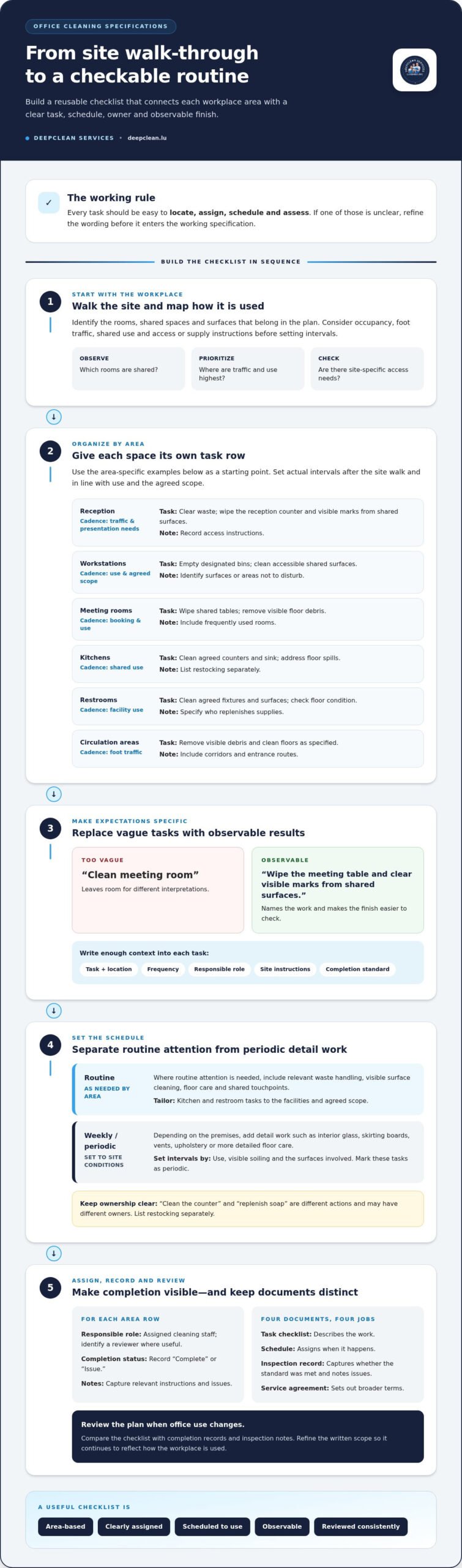
An office cleaning specifications checklist is a written scope that states which tasks are required, where they apply, how often they should be completed, and what finished work should look like. In commercial cleaning, this detail turns a broad service expectation into repeatable work that can be reviewed.
Keep related documents distinct. A task checklist describes the work; a schedule assigns when it happens; an inspection record captures whether the agreed standard was met and notes issues; and a service agreement sets out the broader terms. These documents can refer to one another, but each has a different purpose.
Which details belong in an office cleaning specification?
Give each task enough context to be understood and checked without relying on memory. Record:
- Task and location: Name the action and identify the specific room, fixture, or surface.
- Frequency: State when it is due, using a clear interval or a site-defined trigger.
- Responsible role: Identify who completes the task and, where useful, who reviews it.
- Site instructions: Note relevant access arrangements, supply responsibilities, and building-specific requirements.
- Completion standard: Describe an observable result, such as bins emptied or shared surfaces visibly free of dust and marks.
For example, “clean meeting room” leaves room for different interpretations. “Wipe the meeting table and clear visible marks from shared surfaces” sets a more observable expectation. Specify methods or products only when they are relevant to the site and part of the agreed scope.
How does a checklist improve consistency?
Written specifications reduce variation between shifts and staff by giving everyone the same task descriptions and finish criteria. If a room is missed, a manager can compare the checklist with the completion record and inspection notes instead of trying to reconstruct what happened from memory.
Make the document specific to the workplace. A generic template can provide a starting structure, but the finished checklist should reflect how the office is used: which rooms are shared, which surfaces need attention, and where access or supply instructions matter. Professional services like Athena Team Cleaning rely on tailored scopes to ensure consistent standards across different workplaces. Review it when office use changes so the written scope remains practical.
An effective cleaning checklist makes expectations observable and repeatable. Use this as a simple test: if a task cannot be located, assigned, scheduled, or assessed from its wording, refine it before adding it to the working specification.
Build the Office Cleaning Checklist by Area and Frequency
Organize the checklist around the rooms people use, then set frequencies according to occupancy, foot traffic, and the agreed scope. A shared kitchen used throughout the day may need more frequent attention than a lightly used meeting room. Use the table as a starting point, not a fixed schedule. Walk through the site before setting intervals or assigning responsibilities.
| Area | Task | Frequency | Responsibility | Completion status | Notes |
|---|---|---|---|---|---|
| Reception | Clear waste; wipe reception counter and visible marks from shared surfaces | Set to traffic and presentation needs | Assigned cleaning staff | Complete / issue | Note access instructions |
| Workstations | Empty designated bins; clean accessible shared surfaces | Set to use and agreed scope | Assigned cleaning staff | Complete / issue | Identify surfaces or areas not to disturb |
| Meeting rooms | Wipe shared tables; remove visible floor debris | Based on booking and use | Assigned cleaning staff | Complete / issue | Include frequently used rooms |
| Kitchens | Clean agreed counters and sink; address floor spills | Based on shared use | Assigned cleaning staff | Complete / issue | List restocking separately |
| Restrooms | Clean agreed fixtures and surfaces; check floor condition | Set to facility use | Assigned cleaning staff | Complete / issue | Specify who replenishes supplies |
| Circulation areas | Remove visible debris and clean floors as specified | Based on foot traffic | Assigned cleaning staff | Complete / issue | Include corridors and entrance routes |
What should the daily office cleaning checklist cover?
Where routine attention is needed, include waste handling, visible surface cleaning, floor care, and shared touchpoints in the relevant area rows. Tailor kitchen and restroom tasks to the facilities and agreed scope. Separate cleaning from restocking: “clean the counter” and “replenish soap” are different actions and may have different owners. Clear task descriptions make it easier to assign and review each responsibility.
Which tasks belong on weekly or periodic schedules?
Add detail work that supports, rather than replaces, routine cleaning. Depending on the premises, this may include interior glass, skirting boards, vents, upholstery, or more detailed floor care. Set intervals after considering use, visible soiling, and the surfaces involved. Mark these tasks as periodic so they don’t get lost among routine duties.
For broader workplace service context, see this commercial cleaning services guide. Once you’ve mapped areas and priorities, a tailored office cleaning plan can help turn them into a consistent routine.
Compare Office Cleaning Specifications with Clear, Measurable Criteria
Cleaning proposals can use similar labels while describing different work. Compare the actual scope, not just phrases such as “full office clean.” An office cleaning specifications checklist helps you assess whether each task names a location, frequency, expected finish, and a way to record completion. No single template suits every workplace, so adapt the criteria to your layout, occupancy, and requirements.
| Task | Location | Frequency | Method or finish | Evidence | Exclusions |
|---|---|---|---|---|---|
| Clean shared surfaces | Meeting-room tables | State the agreed interval | Wipe table; finish visibly free of marks and debris | Completion log; note any issue | Personal items; other furniture unless specified |
| Clean floor | Main circulation route | State the agreed interval | Remove visible debris using the agreed floor-care method | Inspection field or recorded exception | Areas blocked or outside the defined route |
These examples describe an observable finish without claiming a specific hygiene outcome. “Clean thoroughly” leaves the location, method, and standard open to interpretation. Naming the surface and visible result makes the task easier to carry out and review. Include relevant touchpoints or shared spaces in the scope, and specify what is covered instead of assuming every surface is included.
How can managers make cleaning tasks measurable?
Break broad instructions into defined actions. A task should identify the surface or area, state the expected finish, and provide a place to record completion. Use the evidence field for a status, an exception, or follow-up needed. A brief note such as “table unavailable” is more useful than marking a task complete when it could not be checked.
How should office cleaning proposals be compared?
Compare equivalent areas, frequencies, assigned responsibilities, and periodic work. If one scope includes a shared kitchen and another leaves it out, they aren’t directly comparable until the difference is clear. Record assumptions and exclusions in writing, including tasks outside the agreed scope. Assess the full service described, not price alone.
Keep technical or regulatory requirements out of the specification unless they’ve been verified for the particular site. A clear comparison shows what each scope covers, where expectations differ, and which details need to be aligned before the cleaning plan can be reviewed consistently.
Put the Office Cleaning Checklist into Practice and Review It
A checklist becomes useful when it guides the work and helps managers respond to missed tasks. Put it into practice with a few clear steps:
- Assess the site. Walk through the office and note the areas, surfaces, access details, and patterns of use the scope needs to cover.
- Assign tasks. Name the role responsible for each task and identify who records or reviews completion.
- Brief staff. Explain the task descriptions, expected finishes, relevant site instructions, and how to flag an exception.
- Inspect agreed areas. Review a consistent sample against the same checklist criteria each time.
- Record and follow up. Log issues with their location, date, action owner, and status until resolved.
- Revise the checklist. Update unclear instructions or task assignments when inspection findings show a pattern.
Keep completion logs, inspection findings, follow-up actions, and dated checklist versions in one accessible record. This gives managers and cleaning staff a shared reference instead of separate notes that are difficult to reconcile.
How should an office manager inspect cleaning quality?
Use a repeatable inspection schedule that fits the office. During the initial rollout, for example, managers might review a sample weekly, then move to a less frequent routine if results are consistent. Increase checks when recurring issues or workplace changes call for closer review. For each finding, record the specific location, what did not meet the agreed criterion, the date, and whether follow-up is complete. Avoid relying on broad impressions such as “the office felt untidy.”
When should an office cleaning checklist be updated?
Review the scope when occupancy, layout, operating hours, or facility use changes. Feedback from people who use and maintain the space can reveal overlooked areas or instructions that are difficult to follow. Date each revision and make the current version easy to identify so staff aren’t working from outdated directions.
Use recurring findings to decide whether to clarify a task, adjust its timing, or change who records completion. A tailored office cleaning specifications checklist should evolve with the site while keeping expectations consistent. For broader service context, explore the commercial cleaning guide. Deepclean Services offers commercial cleaning with online booking at its online service portal.
Choose a Cleaning Plan That Fits Your Luxembourg Workplace
A useful office cleaning plan reflects how the premises are actually used, not just the size of the floor plan. Prioritize areas by foot traffic, shared use, operating hours, and presentation needs. Reception and meeting rooms may need attention because visitors use them, while shared kitchens and restrooms may call for a different routine based on how frequently staff use them. Let those priorities shape the tasks and frequencies in your office cleaning specifications checklist.
How can a checklist fit different office sizes and routines?
For a compact office, start with shared spaces and the tasks that support day-to-day presentation. In a busier or multi-use workplace, divide the site into clear zones and set separate task frequencies where areas have different levels of use. If attendance or room use varies, review the plan periodically and adjust the scope rather than treating the original checklist as permanent.
Operating hours matter, too. They can affect when tasks are practical and which spaces need priority, so include relevant access and timing instructions in the written plan. Keep the details grounded in your premises and agreed service scope.
Should you choose recurring cleaning or a one-time deep clean?
A recurring plan supports ongoing upkeep through a defined routine. A one-time deep clean may be a better fit when the immediate need is a more intensive reset rather than continued scheduled care. Consider the condition of the premises and the purpose of the work, then distinguish routine tasks from periodic detail work in your specifications. For a closer look at how these approaches differ, read this deep cleaning versus regular cleaning comparison.
What can a professional cleaning plan add?
A written scope gives trained cleaning staff clear direction and helps connect site priorities with a flexible schedule and quality-focused service. Deepclean Services provides commercial cleaning for offices across Luxembourg, with plans shaped around the premises and its requirements. Clear task descriptions also give managers a practical basis for reviewing whether the agreed work is being completed consistently.
Before booking, note the areas to be cleaned, the tasks that matter most, and any site-specific instructions. This creates a clear starting point for a plan that fits your workplace. Explore online booking for cleaning services.
Make Your Office Cleaning Plan Clear and Consistent
A practical office cleaning specifications checklist turns expectations into a workable routine: name the areas and tasks, set site-appropriate frequencies, and define how completion will be reviewed. Clear records also help managers spot recurring issues and update the plan as office use changes.
With priorities defined, the next step is putting them into practice. Deepclean Services provides commercial cleaning across Luxembourg, with trained staff, flexible schedules, and a quality-focused approach. Online booking makes it straightforward to move from a written scope to a tailored cleaning plan.
Define your workplace cleaning needs and book online. A clear starting point can make maintaining a clean, well-organized workplace easier to manage.
Frequently Asked Questions
What should an office cleaning specifications checklist include?
An office cleaning specifications checklist should identify each area, task, frequency, responsible role, completion criteria, and a place for notes or inspection results. Add access instructions and clarify who supplies consumables when relevant. Separate routine duties from periodic detail work so each is easy to schedule and review. Tailor the document to the office layout, occupancy, and operating needs, and update it when those conditions change.
How often should an office be cleaned?
There’s no single cleaning schedule that fits every office. Set frequencies according to occupancy, foot traffic, shared facilities, operating hours, and the agreed tasks. A checklist can group duties as daily, weekly, or periodic, with a clear reason for each interval. Review the schedule when workplace use changes, and use inspection records to see whether tasks are being completed as expected or need adjustment.
What is the difference between an office cleaning checklist and a cleaning specification?
A checklist records tasks and whether they’ve been completed. A cleaning specification defines the service in greater detail, including locations, tasks, frequencies, responsibilities, and expected outcomes. The checklist can turn that scope into a working routine and inspection record. Keeping both clear helps managers communicate expectations, track completion, and review whether the agreed work is being delivered without relying on memory or informal updates.
How can I check whether office cleaning has been completed properly?
Compare each reviewed area with observable criteria in the checklist, rather than relying only on a general impression. If a task is missed or incomplete, record the location, issue, date, and follow-up action. Use the same review method over time so findings are comparable. Repeated issues may point to unclear instructions, an unsuitable frequency, or an assignment that needs to be revised.
Should office cleaning specifications include high-touch surfaces?
Yes, include relevant high-touch surfaces when they’re part of the agreed scope. Identify specific shared touchpoints, such as door handles or shared equipment, and state the task and frequency for each. Don’t assume every surface or a particular disinfection method is automatically included. Precise wording helps cleaning staff understand what’s expected and gives managers a practical criterion for reviewing whether the task was completed.
Can one office cleaning checklist work for every workplace?
A basic template can provide a helpful starting point, but the completed checklist should reflect the premises. A compact office may prioritize shared spaces, while a multi-use workplace may need separate zones and task frequencies. Consider the layout, occupancy, facilities, and operating pattern. Keep the structure consistent, then tailor locations, responsibilities, and periodic work. Revisit the checklist when workplace use changes so it remains useful.
How do I compare office cleaning specifications from different providers?
Compare written scopes on equivalent terms: areas, tasks, frequencies, responsibilities, periodic work, and exclusions. Look for descriptions that name specific locations and observable outcomes instead of broad phrases such as “full clean.” Align each scope with the same workplace requirements before considering commercial terms. A side-by-side comparison table can make differences, assumptions, and omissions easier to identify, helping you assess the stated scope fairly.