What if a cleaner’s experience doesn’t tell you whether they’re prepared for your surfaces, hygiene needs, or schedule? A search for trained cleaning staff Luxembourg can raise exactly that question. Cleaning well involves more than completing a checklist: the products and methods need to suit the property and the task.
It’s reasonable to want a clear explanation of what “trained” means before booking. Ask how staff approach different surfaces, how they handle your cleaning requirements, and how the service is organised. Specific answers can help you judge whether a provider is a good fit, without assuming that a label alone guarantees consistent results.
This article explains the practical skills that support careful cleaning, how to assess a provider’s approach, and what to ask before arranging a service in Luxembourg. Deepclean Services states that its staff are trained and offers residential and commercial cleaning, including regular, one-time basic, deep, moving in or out, and mould removal cleaning. We’ll look at how to match the task and property to a service, and what to clarify about products, methods, and scheduling before you book.
Key Takeaways
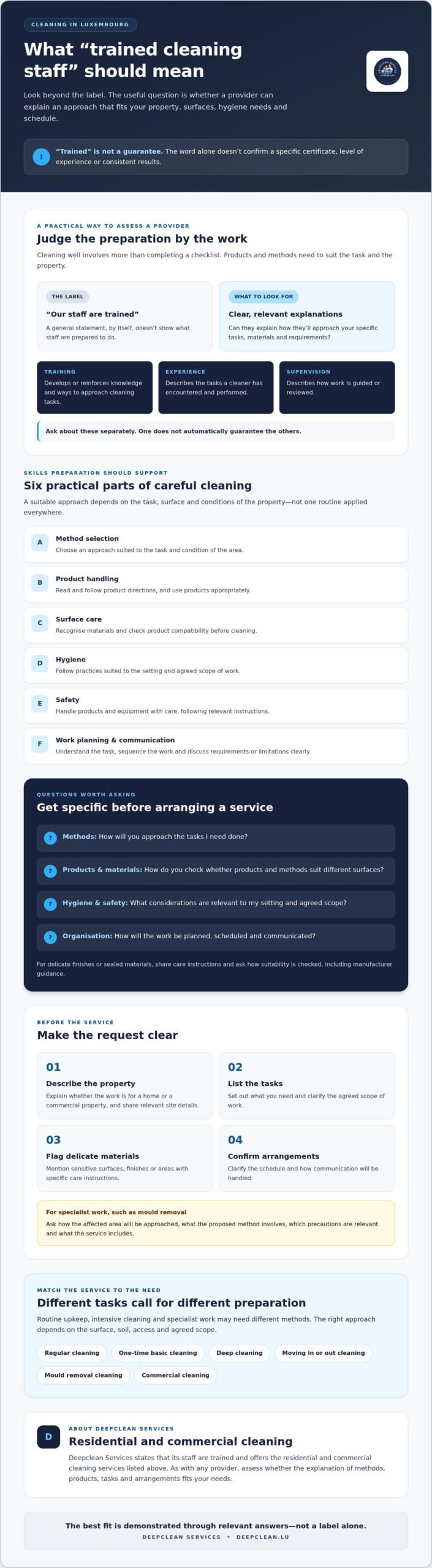
- “Trained” describes preparation for suitable cleaning methods, but the term alone doesn’t confirm a specific certificate or level of experience.
- Assess whether staff can explain how they select products and methods for different tasks, surfaces, hygiene needs, and safety considerations.
- When comparing trained cleaning staff Luxembourg providers, ask practical follow-up questions and look for clear, relevant answers rather than relying on marketing claims alone.
- Before booking, describe your property, list the tasks, flag delicate materials, and confirm the schedule and communication arrangements.
- Match the cleaning service to your needs, whether you’re arranging routine home care or cleaning a commercial property with specific site instructions.
What Does Trained Cleaning Staff in Luxembourg Actually Mean?
“Trained cleaning staff are workers who can explain and apply methods suited to the task, surface, and conditions of the property. A provider’s general claim alone doesn’t demonstrate those skills.” This practical definition makes the phrase trained cleaning staff Luxembourg more useful when comparing services.
Training can develop or reinforce knowledge of cleaning methods, products, surface care, hygiene, safety, and work organisation. But the word “trained” doesn’t, by itself, confirm a particular course, certificate, or amount of experience. Task-specific instruction concerns preparation for a particular job, while supervision refers to how work is guided or reviewed. Ask about these separately rather than assuming one guarantees the others.
The work can also vary by setting. Commercial cleaning includes a range of roles and tasks, so preparation for a commercial site may differ from care in a private home. The useful question isn’t simply whether staff are trained, but whether their preparation matches the work you need.
How Is Training Different From Cleaning Experience?
Experience describes the tasks a cleaner has encountered and performed. Training develops or reinforces ways to approach those tasks. Someone may have substantial experience without formal coursework, while completing a course alone doesn’t show how a person applies a method in a particular property. Neither term guarantees identical results across different sites.
Ask for examples relevant to your request. If you’re booking a deep clean, for instance, ask how the provider approaches a more intensive task compared with routine upkeep. A clear, specific answer can help you judge whether the cleaner’s experience and preparation fit your needs.
Why Do Cleaning Tasks Require Different Preparation?
Routine upkeep and intensive cleaning can call for different levels of attention and different methods. The suitable approach depends on the surface, the type and amount of soil, access to the area, and the agreed scope. Applying one routine everywhere may be unsuitable, particularly when materials need careful handling.
Specialist work can require separate procedures. For mould removal, ask how the affected area will be approached, what the proposed method involves, and which precautions are relevant to the property. Clarify what the service includes. Those details matter more than a broad claim of experience.
Which Skills Should Professional Cleaning Staff Be Prepared to Use?
Competent cleaning depends on a sequence of practical decisions, not one routine applied everywhere. When assessing trained cleaning staff Luxembourg providers, these skill areas offer a useful way to understand what preparation should support:
- Method selection: Choose an approach that fits the task and the condition of the area.
- Product handling: Read and follow product directions, and use products appropriately.
- Surface care: Recognise materials and check product compatibility before cleaning.
- Hygiene: Follow practices suited to the setting and agreed scope of work.
- Safety: Handle products and equipment with care, following relevant instructions.
- Work planning: Understand the task, sequence the work, and communicate clearly about requirements or limitations.
Surface recognition guides product and method choices, helping cleaners avoid treating every material as if it needs the same approach. Clear instructions and communication matter as well. A provider should be able to discuss the agreed tasks and relevant property details so expectations are clear before work begins.
Can Staff Match Cleaning Methods to Different Surfaces?
Delicate finishes, sealed materials, and frequently touched surfaces may call for different considerations. Before work begins, staff should be able to explain how they check whether a product and method are suitable, including how they follow manufacturer guidance. Tell the provider about sensitive materials or areas with specific care instructions. That information helps the team plan the work around the property.
What Do Product Handling and Hygiene Skills Involve?
Good product handling means following directions, using equipment appropriately, and not assuming that stronger or more concentrated products are suitable for every job. Safety Data Sheets provide information about a product’s hazards and handling. The U.S. OSHA Hazard Communication Standard is one reference explaining hazard communication and these sheets. It isn’t a statement of Luxembourg requirements or proof of a cleaner’s credentials.
Hygiene practices depend on the property, the task, and the agreed scope. A home and a commercial site may have different instructions or priorities. Ask what work is included, how relevant hygiene needs will be addressed, and how to share site-specific directions. Clear answers help you decide whether the proposed approach fits the job.
If you’re comparing options for a home or business, explore residential and commercial cleaning services from Deepclean Services.
How Can You Assess a Cleaning Provider’s Training Claims?
A polished promise is not a substitute for clear answers about your requested work. To assess trained cleaning staff Luxembourg providers, focus on what they can explain about the service, the property, and how staff are prepared. Training, service scope, communication, and quality checks are related, but one doesn’t automatically prove the others.
| Claim | Useful follow-up question | Evidence the provider can explain |
|---|---|---|
| “Our staff are fully trained.” | How are cleaners prepared for this service and property type? | A clear description of relevant preparation, without relying only on a broad label. |
| “We use the right products.” | How do staff check product instructions and surface compatibility? | An explanation of how product directions and material concerns are considered. |
| “The service is tailored to your needs.” | What happens if the requested tasks or scope change? | A practical explanation of how changes are clarified before work proceeds. |
| “Quality is a priority.” | How can I raise a question about the agreed work or request follow-up? | A clear contact route and explanation of how service concerns are handled. |
What Questions Should You Ask Before Booking?
Keep the conversation specific. Describe the property and the service you’re considering, then ask how staff are prepared for that type of work. Ask how cleaners follow product instructions and handle sensitive surfaces, and how they’ll confirm any change in scope. Clarify who to contact if an instruction is unclear or the completed work needs follow-up. Straightforward answers help align expectations before the booking.
What Evidence Is Helpful, and What Should You Verify?
Look for explanations connected to your task, not just phrases such as “expert team” or “fully trained.” Certificates may be relevant to particular work, but don’t assume one certificate is required for every cleaning service or that it proves every staff member’s practical competence. If a provider cites a certificate or legal requirement, ask what it covers and verify that it applies to the work under current Luxembourg rules.
The Cleaning Industry Management Standard (CIMS) is an industry reference you can explore when considering organisational systems. Understand a standard or certification claim in context: it doesn’t, by itself, demonstrate how a particular cleaner will handle your task. Reviews, years in business, and job titles may provide context, but they don’t independently establish technical skills. Ask for a relevant explanation and assess how clearly the provider connects its preparation to your needs.
How Should Training Match Your Home or Commercial Cleaning Needs?
Preparation is most useful when it reflects the property and the work requested. Before booking trained cleaning staff Luxembourg, give the provider enough detail to understand the setting, priorities, and practical arrangements. Use this process to make the conversation clear:
- Describe the property. Explain whether it’s a home or commercial premises, and mention relevant layout or access details.
- Define the tasks. List the areas and work you want included. Be specific about priorities rather than assuming every room or surface is covered.
- Flag materials and concerns. Point out delicate finishes, sensitive areas, or other details that may affect product and method choices.
- Confirm the schedule. Agree on a suitable time and clarify timing constraints, especially if people will be using the premises.
- Agree on communication. Establish who can clarify instructions or discuss a change to the agreed scope.
A household may need recurring upkeep, while a commercial property may have access arrangements, operating hours, or site instructions to consider. The right preparation depends on those details, not simply on whether a cleaner has worked in a similar setting before.
What Should Households Tell a Cleaning Provider?
Identify the rooms to be cleaned, your priorities, and any sensitive surfaces or access arrangements. Share special concerns in advance so the provider can discuss whether they fit the requested scope. A clear description helps staff prepare for the job, but it doesn’t promise a particular result or mean every task is automatically included.
If you’re considering ongoing household care, see the guide to regular cleaning. If you’re unsure whether the work calls for routine upkeep or a more intensive visit, compare deep cleaning versus regular cleaning before deciding what to request.
What Should Organisations Clarify Before a Cleaning Visit?
Organisations should describe the facility, access conditions, priority areas, and any site-specific instructions. Agree on timing and a contact person, particularly if the premises will be occupied or operational during the visit. Requirements can vary between workplaces, so explain what matters at your site rather than assuming one standard approach will fit.
The commercial cleaning guide can help organisations consider workplace requirements and define what they need to discuss with a provider. A clear scope and good communication help staff prepare, but they don’t replace checking that the requested work is understood.
Ready to outline your household or workplace needs? Explore cleaning services and book online with Deepclean Services.
How Deepclean Services Approaches Trained Cleaning Staff in Luxembourg
Deepclean Services states that it provides trained staff, flexible schedules, online booking, and a focus on quality. Consider these details alongside practical questions about which tasks are included, what the property requires, and how specific concerns will be discussed. The company serves residential and commercial properties across Luxembourg, so describe your setting and requested work when exploring a service.
Which Cleaning Services Can Customers Explore?
Available options include regular cleaning, one-time basic cleaning, deep cleaning, moving in or out cleaning, and mould removal. The right option depends on the property, the work needed, and the scope agreed with the provider. A service name is a starting point, not a substitute for confirming which areas and tasks are included.
For routine household care, clarify which tasks you want covered regularly. If you’re preparing a property for a move, explain which rooms and priorities matter. If you’re asking about mould removal, describe the concern and ask what the service includes. Don’t assume every staff member carries out every specialist service. Confirm that your requested task can be addressed as part of the service you’re considering.
What Is a Practical Next Step Before Booking?
Prepare a short description before you book. Include the property type, the service you’re considering, your priorities, preferred schedule, and any materials or areas that need particular attention. Then ask service-specific questions: How are staff prepared for this kind of work? Which tasks are within the agreed scope? How should you raise a question if details need clarification?
Online booking can make arranging a service more convenient, but it doesn’t replace clarifying the work itself. Deepclean Services offers online booking and flexible schedules as practical ways to proceed. These features are separate from evidence about staff preparation. If you want more detail on using an online booking process, consult the guide to booking a cleaning service online in Luxembourg.
With your property details and questions ready, explore the available options at a pace that suits you. Explore Deepclean Services and consider which service best matches your task and schedule.
Choose a Cleaning Service That Fits Your Property
“Trained” is most useful when a provider can explain how staff preparation relates to the task, surfaces, and setting. A certificate or confident marketing phrase alone won’t tell you whether the proposed work suits your needs. Ask clear questions about methods, products, scope, and communication, then compare the answers with the requirements of your home or workplace.
When assessing trained cleaning staff Luxembourg providers, describe your property, priorities, schedule, and any sensitive materials before booking. This gives the provider a clearer basis for discussing a suitable service and what the work includes.
Deepclean Services states that it provides trained staff and offers residential and commercial cleaning across Luxembourg. Flexible schedules and online booking are available service features, making it straightforward to explore options and take a practical next step.
Have your key details ready, then explore Deepclean Services to consider which cleaning service may fit your property and task. With clear expectations from the start, you can make a more confident choice.
Frequently Asked Questions
What does trained cleaning staff mean?
Trained cleaning staff are workers prepared to choose and carry out cleaning methods suited to the task and property. This may involve understanding product directions, surface care, hygiene, safe equipment use, and work planning. The term alone doesn’t confirm a particular course, certificate, or amount of experience. Ask the provider how staff preparation relates to your requested service instead of relying on the label by itself.
Do cleaning staff in Luxembourg need a formal certificate?
A formal certificate shouldn’t be assumed to be required for every cleaning task in Luxembourg. Requirements may depend on the type of work and any rules that apply, so check current official guidance or ask a provider to explain the basis for a claimed requirement. A certificate can indicate specific learning, but it doesn’t automatically show how staff will handle every surface, property, or cleaning task.
How can I check whether a cleaning company trains its staff?
Ask the company how staff are prepared for the service and property type you need, and request practical examples. Find out how cleaners are expected to follow product instructions, respond to sensitive materials, and clarify changes to the agreed scope. Deepclean Services states that it provides trained staff, but specific training courses or procedures aren’t confirmed here. Clear, relevant answers are more useful than a broad claim such as “fully trained.”
What skills should professional cleaners have?
Professional cleaners should be prepared to select suitable methods, follow product directions, care for different surfaces, use equipment appropriately, and work according to the agreed hygiene and safety needs. Planning and communication matter too: staff need to understand the requested tasks and raise questions if instructions are unclear. The most relevant skills depend on the property and scope, so ask how the provider’s approach fits your particular job.
Are trained cleaners better for delicate surfaces?
Appropriate preparation can help cleaners recognise that delicate finishes may need different product and method choices, but the word “trained” alone doesn’t guarantee a particular outcome. Tell the provider about sensitive materials and any care instructions before the service. Ask how product compatibility will be checked and whether manufacturer guidance will be followed. If a surface needs special handling, clarify the proposed approach and whether it falls within the agreed scope.
Does cleaning staff training differ between homes and commercial properties?
Preparation should reflect the setting and the work requested. A home may require attention to household priorities, access, and sensitive materials. A commercial property may involve additional site instructions, access arrangements, timing considerations, or communication with a workplace contact. Don’t assume experience in one setting automatically covers another. Describe the property and ask how staff preparation and the proposed scope relate to its specific requirements.
What should I ask before booking cleaning staff in Luxembourg?
Before booking, describe your property, list the tasks and priorities, flag delicate materials, and explain any access or schedule constraints. Ask how staff are prepared for that service, how products and surfaces are considered, and what happens if the scope needs clarification. Confirm who you can contact with questions about the agreed work. These practical details help you assess whether the provider’s approach fits your needs.