A dependable cleaning quote starts with the work required, not a guessed flat rate. A deep cleaning house cost calculator estimates the time needed from the service scope, home size and cleaning frequency, then uses the target hourly rate and team size to calculate a customer price. For Luxembourg customers, present the final quote in euros and base it on the actual tasks involved.
It’s easy to focus on the hourly rate alone, but a clear estimate also accounts for how much work the home needs and how often the service will take place. This guide explains how to combine those factors when quoting customers, without relying on prices from another market.
You’ll learn how to estimate labour time, distinguish a deep clean from regular upkeep, and account for cleaning frequency. You’ll also see when Deep Cleaning can suit a first-time or more thorough clean, and how to choose the next step.
Key Takeaways
- Estimate cleaning time from the home’s size, service scope, condition and cleaning frequency before calculating a quote.
- For apartments and condos, account for the rooms and tasks to be cleaned rather than relying on floor area alone.
- Build a clear customer quote by listing each service separately, describing its scope and showing the applicable rate in euros.
- Set a target hourly rate that reflects labour, team size and operating costs, then use it consistently in your estimates.
- Separate deep-cleaning and one-time work from recurring upkeep, and adjust estimates for the property’s location, layout and specific needs.
How do I quote customers for my house cleaning services?
Build an estimate around the work requested, the home’s layout and the planned visit frequency. A deep cleaning house cost calculator organizes those details into estimated labour time and a customer price.
Cleaning Effort and Cost Estimates
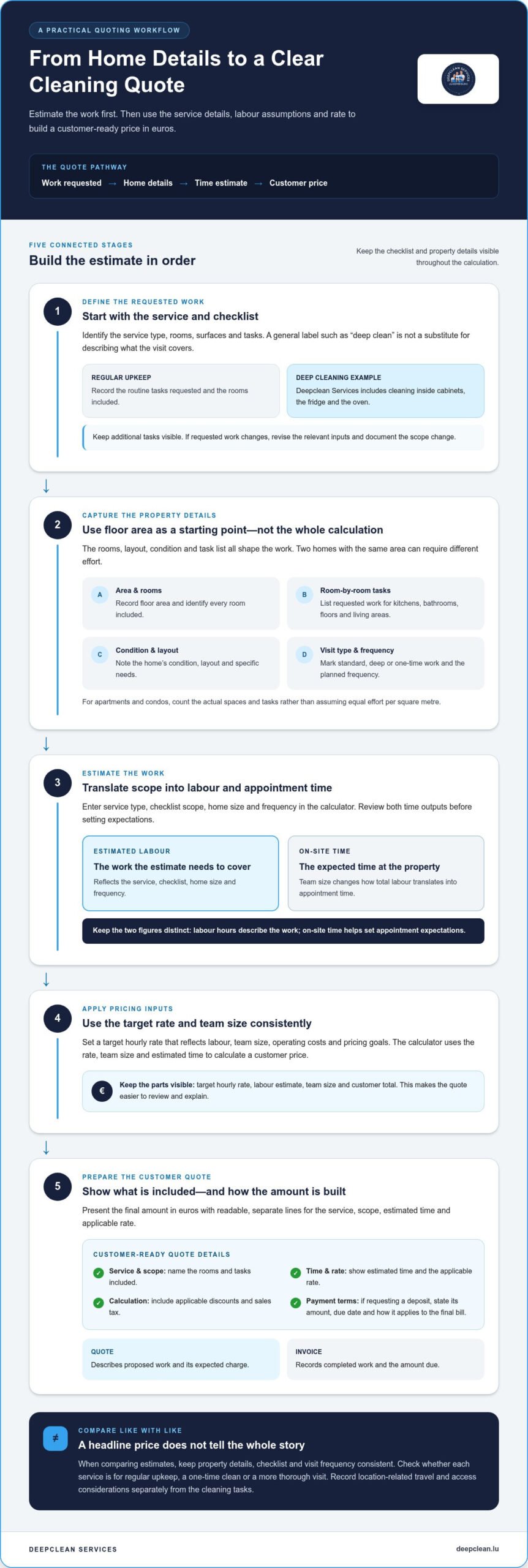
The amount of work determines how much labour an estimate needs to cover. Start with the selected service and checklist, then note the rooms, surfaces and tasks included. A home needing detailed attention differs from one requiring routine upkeep, even if their floor areas are similar. Keep additional tasks visible so the estimate reflects the work.
Square-Footage Time Estimates
Use floor area as a starting point for estimating cleaning time, not as the whole calculation. Consider the home’s size, room layout, requested tasks and cleaning frequency. In apartments and condos, a compact floor plan can still include several kitchens, bathrooms or detailed areas. Count the actual spaces and tasks instead of assuming equal effort per square metre.
For an apartment or condo, gather the details that shape the visit before entering calculator inputs:
- Record the floor area and identify the rooms included in the service.
- List the requested tasks for kitchens, bathrooms, floors and living areas.
- Note whether the request is a standard clean, deep clean or one-time visit.
- Include the planned frequency, since recurring upkeep changes the workload.
This checklist gives the estimate a useful basis. Two units with the same area may need different amounts of work if one has more rooms or a more detailed scope.
The calculator estimates cleaning time from service type, checklist scope, home size and frequency. It then calculates a customer price using the target hourly rate, team size and estimated time. The team-size input also changes how total labour translates into on-site time. Review both figures: labour hours describe the work, while on-site time helps set expectations for the appointment.
Turn the result into a customer-ready estimate by showing the service, scope, estimated time and rate in separate, readable lines. Add any applicable discounts and sales tax to the calculation, and present the final amount in euros. For a deposit, state the requested amount, due date and how it applies to the final bill. Make the message easy to follow, and identify any tasks outside the quoted checklist before the customer accepts.
Using a calculator to prepare client quotes
Across Luxembourg, compare deep-cleaning quotes by checklist and scope, not by headline alone. A useful estimate identifies the rooms, tasks, labour assumptions and any additional work, so the customer can see what the proposed service covers. Keep property details consistent when reviewing estimates, including the home’s layout and condition. This makes differences in the quoted work easier to understand.
The price depends on the home’s size and condition, requested tasks, labour time, team size and service frequency. A quote tailored to the property gives the exact figure for that case.
Use a calculator to turn a customer’s details into a consistent estimate. Enter the service type, checklist scope, home size and frequency, then apply the cleaning business’s target hourly rate and team size. Review both estimated labour and on-site time before sending the result. If the requested work changes, revise the relevant inputs instead of changing the total without explanation.
Keep customer quotes and invoices as separate records. The quote describes proposed work and its expected charge; the invoice records completed work and the amount due. For both documents, record the property, agreed tasks and any scope changes. If the customer adds a task after accepting the quote, document it and update the estimate before treating the new work as included.
A clear service description makes it easier to understand what a cleaning visit covers. Specify the rooms and tasks requested instead of relying on a general label such as “deep clean.” For Deep Cleaning, Deepclean Services includes cleaning inside cabinets, the fridge and the oven. Review the requested scope so it matches the service you need.
Use this sequence to prepare a clear quote:
- Record the home’s layout, condition and requested checklist.
- Select the service type and visit frequency.
- Enter the team size and target hourly rate.
- Review estimated labour, on-site time and itemised tasks.
- Send the estimate with its scope and payment terms.
For location-based comparisons, keep the task list and property details consistent across estimates. A home’s location may affect travel and access considerations, while its layout affects the cleaning work itself. Record these factors separately, and explain how they influence the estimate. This gives the customer useful context without confusing operational details with the tasks included in the cleaning service.
There isn’t one price that represents every home’s cleaning needs. Compare services by checking the same property details, checklist and visit frequency, and note whether each option is for regular upkeep, a one-time clean or a more thorough visit.
For a household estimate, a clear cleaning quote should describe the requested tasks and how the work is calculated.
Target hourly rates and customer pricing
Select a target hourly rate that reflects the cleaning business’s operating costs and pricing goals in Luxembourg. A calculator applies that rate to estimated labour, then uses team size to convert total work into on-site time. Keep the rate, labour estimate and customer total distinct. This lets you review each part of a quote and explain how the final amount relates to the requested work.
Start by calculating what it takes to deliver one cleaner hour. Account for wages, employer costs, supplies, transport, equipment and administration. Then choose a rate that supports the business’s pricing goals. The customer’s total should reflect the estimated labour and agreed scope, rather than simply the number of hours the cleaner spends at the property.
For Luxembourg estimates, base the target rate on the business’s own costs and operating conditions. Avoid importing rates from another country: labour markets, currencies and business expenses differ. Instead, select a consistent internal rate, apply it to the estimated work, and review whether it remains suitable as operating costs or the services offered change.
Keep the hourly rate separate from tax settings in the calculator. Select the appropriate setting for the quote, then display any applicable tax separately from the service amount. Apply the same approach across estimates and invoices, and use the business’s accounting process to determine the correct treatment. This helps customers distinguish cleaning labour from tax and other parts of the total.
Room-based pricing can clarify how a property’s layout affects effort, even when the estimate uses an hourly calculation. Compare a home with two bedrooms and one bathroom against a similar-sized home with more bathrooms and a larger kitchen. The second checklist may require more work. List rooms separately when useful, but don’t assign unsupported standard rates to them.
Before sending a customer price, follow these steps:
- Set the target hourly rate from the business’s operating costs.
- Enter estimated labour and team size.
- Review total labour and expected on-site time.
- Apply the relevant tax setting and display it clearly.
- Check that room-based items match the agreed checklist.
For example, selecting a team of two should distinguish total cleaner labour from the time the team spends at the home. That prevents the hourly rate from being confused with the appointment’s full duration. If the customer changes the rooms, tasks or visit frequency, update the estimate inputs. The final quote should connect the chosen rate to the current scope, with each part clear enough for the customer to review.
Deep-cleaning and one-time service costs
A deep clean takes more detailed work than routine upkeep, especially in neglected areas or where dust and grime have built up. For one-time quoting, define the tasks first, then estimate labour from the checklist, home size and team required.
The exact figure depends on the property’s size and condition, requested tasks, labour time and team size. A quote for the specific home gives the customer the relevant amount.
A Deep Cleaning checklist should name each room and task, including kitchen surfaces, bathrooms, floors and areas needing extra attention. Deepclean Services’ Deep Cleaning includes cleaning inside cabinets, the fridge and the oven. Be specific about any other tasks you want included.
- List the rooms included, such as the kitchen, bedrooms and bathrooms.
- Describe the requested work for each room, including floors and surfaces.
- Identify neglected areas or built-up grime needing additional attention.
- Separate optional tasks from the agreed checklist.
The work involved depends on the home and its current condition. For example, a home with two bathrooms may need a different task plan from one with a single bathroom, even if their floor areas match. A first-time visit may also call for different tasks from regular upkeep. Describe these details when choosing a service.
The work required can change when the checklist expands or additional rooms and bathrooms need attention. Property size matters, but so do condition and scope. When arranging a cleaning, state each requested task clearly. Deep Cleaning includes the inside of cabinets, the fridge and the oven, so identify any other work you’d like included.
Before booking, review the written quote, insurance details and cancellation terms. Confirm which rooms and tasks are included, how changes are handled, and what the cancellation conditions say. Keep the accepted scope and terms with the booking message, so both sides can refer to the same details.
For a one-time visit, distinguish Deep Cleaning from basic cleaning by identifying the extra attention the home needs. Deepclean Services’ Deep Cleaning includes cleaning inside cabinets, the fridge and the oven. This makes the service scope clear beyond the home’s size alone.
Finally, calculate the estimate from the completed scope, labour time and team size. Show the customer the included work and any separately quoted additions. If the customer changes the checklist before the appointment, revise the estimate to match the updated tasks.
How does cleaning frequency affect the cost estimate?
Cleaning frequency changes the home’s starting condition and the work required at each visit. A deep clean may involve detailed attention first, while weekly, bi-weekly or monthly upkeep follows a different task plan. For a Luxembourg estimate, consider property size, location and requested tasks together. Don’t assume that homes with similar floor areas need identical labour or the same visit schedule.
Calculate a deep-cleaning quote by recording the home’s floor area, room layout, condition and requested checklist. Estimate labour for each task, total the time, then apply the target hourly rate and team size. Use floor area as context, while accounting for bathrooms, kitchen work and neglected areas individually.
Property size helps structure the estimate, but equal floor areas can require different workloads. A compact apartment with several detailed rooms may take more effort than a larger, open-plan home with a shorter checklist. Map each room to its tasks, record additional areas, and revise estimated labour when the scope changes. This ties the quote to the home’s actual cleaning requirements.
Location can affect the operating calculation as well. Travel, access arrangements and equipment transport may influence the time and overhead allocated to a job. Record these considerations separately from cleaning labour. For example, note access restrictions apart from bathroom tasks, so the estimate explains which operational detail or cleaning requirement affects the planned work.
- Record the floor area and room layout.
- Select weekly, bi-weekly, monthly or one-time service.
- List deep-cleaning tasks and describe the home’s condition.
- Estimate labour by task, then account for team size and location.
- Revise the checklist when the requested scope changes.
Frequency helps explain the estimate, but it doesn’t replace reviewing the scope. A one-time visit may address accumulated grime, while regular visits focus on upkeep. Compare both using the same task categories, then adjust estimated effort to reflect the work each visit covers. This keeps the calculation specific to the service rather than treating every appointment as equal.
To compare a one-time deep clean with recurring visits, identify which tasks are needed initially and which belong to routine upkeep. The first visit may include neglected areas; later appointments may require less detailed work. Use the checklist and current home condition to estimate labour for each visit pattern, rather than assuming each appointment takes the same time.
For a property-specific estimate, request a tailored cleaning quote based on the home’s size, location and requested tasks.
Deepclean Services: Regular Cleaning
Deepclean Services provides Regular Cleaning for homes that need consistent upkeep, with a scope suited to the property and requested tasks. Choose this service when routine care is the priority; a first-time visit, accumulated grime or detailed attention to neglected areas may call for Deep Cleaning instead. One-Time Basic Cleaning and Moving In / Out Cleaning address different one-off needs.
To plan the right service, consider the home’s condition, rooms and cleaning checklist. A clear scope helps align the visit with what you want maintained, whether you need recurring household care or a more thorough reset. Share the property details and requested tasks so the service can be matched to your needs.
Contact Deepclean Services to discuss your cleaning requirements, or visit deepclean.lu.
Turn Your Estimate Into a Clear Next Step
A quote is most useful when it helps you choose the right level of care for your home. Use a deep cleaning house cost calculator as a planning aid, then match its estimate to the tasks you want completed. That makes it easier to explain your priorities and decide whether you need ongoing upkeep or a more thorough one-time visit.
Deepclean Services offers Regular Cleaning, One-Time Basic Cleaning and Deep Cleaning. Regular Cleaning supports ongoing upkeep, while Deep Cleaning provides a more thorough service. Share the property details and tasks you want completed, then choose the option that fits your needs.
Contact Deepclean Services for a quote and describe the cleaning support you’re looking for. A clear starting point can make planning your home’s care simpler and more manageable.
Frequently Asked Questions
How long should this cleaning take?
The calculator estimates labour and converts it into on-site time based on the selected team size. A larger team can complete the same total labour in a shorter visit, while one cleaner may need longer. Use the on-site estimate to plan access and household routines, then make sure the scope includes details such as occupied rooms, pets or delicate surfaces that may affect the work sequence.
Can I use this calculator for apartments or condos?
Yes. Consider the apartment or condo’s size, select the service that fits your needs, and identify the rooms and tasks you want included. For a shared building, keep the requested work focused on your private unit unless you also need common areas cleaned. Distinguish a private entrance from a building lobby so the scope is clear.
Can the calculator handle complex or large properties?
It accepts a whole-number team size from 1 to 50 cleaners. For a property with several wings or distinct living areas, divide the checklist into clear zones and include each area in the scope. The team-size input helps convert total labour into on-site time, while a detailed task list makes the estimate easier to review for large or unusually arranged homes.
Does the estimate include taxes or fees?
Tax treatment depends on the calculator settings and how the quote is prepared. The estimate example described in the calculator excludes sales tax on materials and supplies, so don’t assume every displayed total includes every tax or fee. Show applicable taxes separately in the customer-facing quote, and identify any additional charge by its purpose rather than grouping it under cleaning labour.
How are you calculating these prices?
The calculator uses the selected service type, checklist, home size and cleaning frequency to estimate the work time. It then combines estimated labour with the target hourly rate and team size to calculate the customer amount. For example, changing the requested checklist can alter estimated time even when the home’s size stays the same. Review the inputs before treating the result as a finished quote.
What factors affect a deep house cleaning cost estimate?
The estimate is shaped by the tasks requested, the home’s size and condition, the number of cleaners, and how often service is scheduled. A first-time visit with built-up grime calls for a different task scope than maintenance in a regularly cleaned home. Add requested extras as distinct items, so customers can see how each added task affects the overall estimate.
How do house size and number of bedrooms affect deep cleaning prices?
A larger home often has more rooms and surfaces, but bedroom count alone doesn’t show the full workload. A home with fewer bedrooms may still need more attention if it has multiple bathrooms, shared spaces or detailed tasks. Consider the floor area and describe the actual checklist when choosing a service.